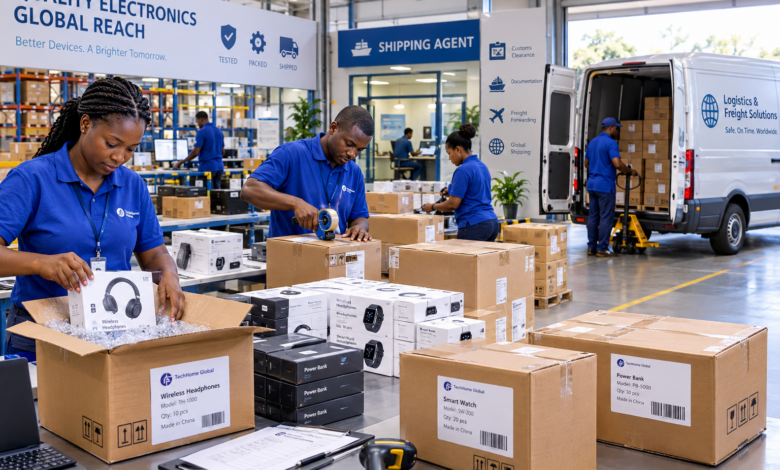
Welcome to Phase 2. At this stage of your procurement journey, your factory has completed production. Your independent quality inspector has signed off on the inventory, and your goods are packed securely in master cartons sitting on the factory dock.
Phase 2: Logistics and Transport—
Moving Your Inventory Safely Across the Globe
Now comes the most logistically intense part of the process:
moving your physical goods from a factory floor in Asia across international borders to your final storage destination. If Phase 1 was about protecting your manufacturing budget, Phase 2 is about preventing your shipping costs from eating your entire remaining profit margin. With your allocated
$2,500 logistics budget, you must navigate the complex landscape of international freight forwarders, cargo modes, and hidden port fees. This step-by-step guide will demystify the transport phase and ensure your goods arrive smoothly, legally, and on budget.
Step 1: The Golden Rule of Logistics—Fire Your Supplier as Your Shipper
The most common mistake first-time Alibaba buyers make is asking their manufacturer to handle the international shipping. It sounds convenient: the supplier says,
“We can ship this directly to your house for $1,200.” Do not accept this offer. Factories are experts at manufacturing, not global logistics. When a supplier arranges shipping, they almost always do one of two things:
- They subcontract the shipping to a local freight agent, add a massive markup, and pocket the difference as extra profit.
- They ship your goods under an unstable Incoterm like CIF (Cost, Insurance, and Freight). This means they pay for the ocean voyage, but when the ship docks in your country, you are hit with thousands of dollars in surprise “destination port handling fees” before you can claim your cargo.
Instead, you must hire your own independent
freight forwarder. Think of a freight forwarder as a travel agent for your cargo. They don’t own the planes or ships, but they manage the entire journey, coordinate customs clearance, provide transparent tracking, and protect you from hidden terminal fees.
Step 2: Choosing the Right Transport Mode (Air vs. Ocean)
Your choice of transport directly impacts your timeline and your
landed cost. You must choose the mode that matches the weight and volume of your shipment.
-
Air Express (Courier)
- How it works: Door-to-door delivery via networks like DHL, FedEx, or UPS.
- Timeline: 3 to 5 business days.
- When to use it: Your total shipment weight is under 150 kilograms (330 lbs), or your product is a high-margin, lightweight item (e.g., jewelry, electronics).
- The Reality: It is highly expensive but completely hands-off. The courier handles all customs paperwork automatically and delivers straight to your doorstep.
-
Air Freight
- How it works: Commercial cargo planes move your goods from airport to airport.
- Timeline: 5 to 10 days.
- When to use it: Your shipment weighs between 150 kg and 500 kg. It is more cost-effective than a courier, but you must arrange independent trucking to collect the goods from your local airport cargo terminal.
-
Sea Freight (Ocean Freight)
- How it works: Your goods are loaded onto giant container ships.
- Timeline: 30 to 45 days (depending on your global location).
- When to use it: Your shipment weighs over 500 kg or occupies massive physical volume measured in CBM (Cubic Meters).
- The Reality: This is the absolute cheapest shipping method per unit. If you are shipping heavy items like furniture, fitness equipment, or bulky packaging, this is your only viable path to stay within your $2,500 budget.
Step 3: LCL vs. FCL (Navigating the Ocean)
Refer to our Incoterms guide
here If you choose sea freight, your freight forwarder will ask you to choose between two container loading methods based on your total cargo volume:
- LCL (Less than Container Load): Your shipment shares space inside a single 20-foot or 40-foot container with goods belonging to dozens of other importers. You only pay for the exact volume (CBM) your boxes occupy. This is the default choice for your initial $4,000 production run.
- FCL (Full Container Load): You rent an entire shipping container exclusively for your brand. No one else’s goods can enter it. FCL is cheaper per CBM than LCL, but it requires a massive inventory volume to justify the cost.
Step 4: Sourcing and Vetting a Freight Forwarder
To find a reliable freight forwarder, bypass Alibaba’s built-in logistics tab and look for established international digital platforms like
Freightos or
Flexport, or use local, licensed freight forwarding agencies in your home country. When requesting a shipping quote, send your forwarder the exact data you secured during Phase 1:
- The Pickup Address: The supplier’s factory address or the designated FOB port (e.g., Ningbo Port, China).
- The Delivery Address: Your home, warehouse, or an Amazon FBA fulfillment center.
- The Packing Specifications: Total number of cartons, exact dimensions per carton, total weight, and total CBM.
- The Incoterm: Tell them: “This shipment is booked under FOB terms.”
Step 5: Understanding Your Shipping Quote Line Items
A legitimate freight forwarder will send you a highly detailed line-item quote. Do not be intimidated by the industry jargon. Here are the core costs you must review to ensure you stay within your budget:
- Ocean Freight / Origin Charges: The cost of the physical transit across the ocean or air.
- Customs Clearance Fee: The service fee you pay the forwarder’s internal customs broker to process your legal entry documents with the government (typically $100 to $150).
- Customs Bond: In many countries (like the US), you must purchase a legal bond ensuring you will pay your taxes. A Single Entry Bond costs around $50, while a Continuous Bond (valid for a full year) costs roughly $250.
- ISF Filing (Importer Security Filing): For sea freight heading to destinations like the US, this document must be filed electronically 24 hours before the ship leaves China. Missing this deadline results in an automatic $5,000 fine from customs.
- Destination Terminal Handling Charges (DTHC): The cost for port cranes to unload your container from the vessel onto the ground.
- Delivery / Final-Mile Drayage: The cost of hiring a local truck to bring the boxes from the port to your final doorstep.
Step 6: Calculating Tariffs and Duties (The HS Code Check)
Your freight quote covers the cost of moving the box, but it
does not include import taxes imposed by your local government. To calculate your exact tariff liability, you must use the
HS Code (Harmonized System Code) provided by your supplier in Phase 1. Take that HS Code and check it against your national tariff database (such as the USITC for the United States or the local customs tariff portal for your country).
- Example: If your product value is $4,000 and the tariff rate for your specific HS Code is 6.5%, you will owe the government $260 in customs duties.
- Warning: Always check if your product is subject to punitive anti-dumping duties or trade war tariffs, which can instantly add an extra 25% or more to your costs. Knowing this number before the ship sails ensures your $2,500 logistics budget isn’t completely blown at the border.
Step 7: The Final-Mile Delivery
Once your cargo successfully clears customs inspection at the port of entry, it enters the final leg of its journey:
final-mile logistics. If your inventory is heading to a standard home or commercial office, your forwarder will arrange a local delivery truck equipped with a
liftgate if you do not own a commercial loading dock or forklift. If your inventory is destined for
Amazon FBA, your freight forwarder must split the shipment onto standard pallets, apply unique Amazon carton labels, and book a specialized delivery appointment via Amazon’s Carrier Central portal.
Phase 2 Summary Checklist: Tracking Your Logistics Costs
| Cost Category | Estimated Expense | What It Covers | Budget Action |
| International Freight | $1,200 – $1,500 | LCL Ocean transits from a Chinese port to a domestic port. | Compare quotes across 3 forwarders. |
| Customs Brokerage & Bond | $250 – $350 | Legal entry documentation and customs bond purchase. | Handled completely by your forwarder. |
| Government Tariffs / Duties | $200 – $400 | Taxes are based directly on your product’s HS Code value. | Pre-calculate using your factory invoice. |
| Final-Mile Trucking | $300 – $500 | Delivering cartons from the local port terminal to your door. | Ensure liftgate service is included if needed. |
| Total Estimated Logistics Cost | $1,950 – $2,750 | The entire door-to-door transit cycle. | Fits comfortably within your $2,500 target. |
By choosing an independent freight forwarder, verifying your HS codes early, and securing an FOB agreement, you retain complete financial control over your supply chain. Your inventory is no longer stuck across the world—it is cleared, transported, and moving directly to your location.