Phase 3:
Launch and Profit—Turning Your Alibaba Inventory into Cash Flow
Welcome to the final and most exciting phase of your e-commerce journey. So far, your $10,000 seed capital has been working silently behind the scenes. You allocated $4,000 to manufacture premium goods in Phase 1, and you spent roughly $2,500 safely moving that inventory across the ocean and through customs in Phase 2.
Now, your master cartons have officially arrived at your doorstep or your Amazon FBA fulfillment center. You have $3,000 left at hand, dedicated entirely to marketing and launching.
This is the tipping point. Many entrepreneurs think the hardest part is over once the product is made and shipped.
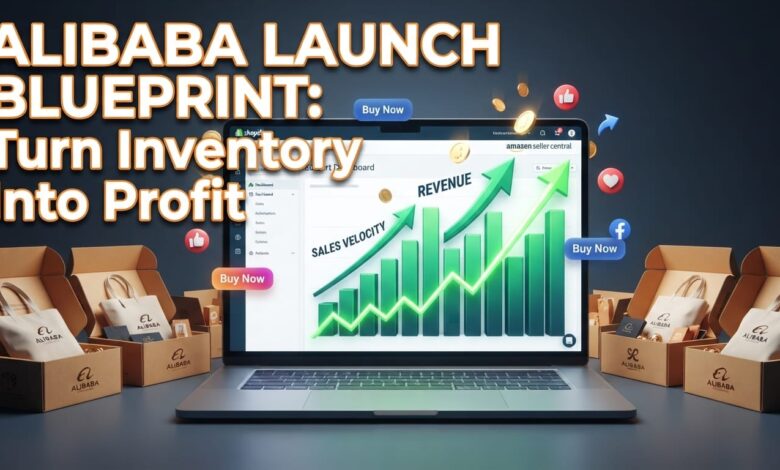
In reality, a great product sitting silently in a warehouse generates zero profit. Phase 3 is about velocity—taking your remaining capital and deploying it efficiently to drive traffic, convert visitors into high-paying customers, and protect your margins. This step-by-step blueprint will guide you through your launch phase, transforming your physical stock into an active cash-flowing asset.
Step 1: Building a High-Converting Sales Infrastructure
Before spending a single dollar on digital advertising, your digital storefront must be bulletproof. Traffic is expensive; driving visitors to a sloppy, slow website is the fastest way to burn through your remaining $3,000.
Whether you are launching a standalone store or setting up a listing on Amazon FBA, your sales page must focus on conversion rate optimization (CRO):
1. Professional Product Photography
Do not use the generic, low-resolution photos supplied by your Alibaba manufacturer. If your listing looks identical to five other sellers using the same factory images, you immediately lose your competitive edge.
Spend $400 to $600 of your budget to hire a local product photographer or a specialized e-commerce agency. You need:
-
- Hero Shots: Clean, crisp images of your product against a pure white background.
- Lifestyle Shots: High-quality photos showing the product being used in real-world scenarios by your target demographic.
- Infographics: Images edited with text overlays highlighting key benefits, exact dimensions, or premium material specifications.
2. The Benefits-Driven Copywriting Framework
Stop writing descriptions that merely list features (e.g., “This bag is made of 12oz canvas”). Instead, translate those features into emotional benefits for the buyer (e.g., “Engineered with reinforced 12oz double-stitched canvas, this tote easily carries your laptop and daily essentials without ever fraying or tearing”). Break your copy into scannable bullet points and bold your key phrases to capture short attention spans.
Step 2: The $3,000 Launch Budget Allocation Blueprint
With exactly $3,000 left at hand, your marketing spend must be precise, measurable, and highly calculated. We cannot afford vanity metrics like “social media likes.” We need direct sales.
We will divide your launch budget using a Lean Launch Framework:
-
- Visual Assets & Creative ($600 – 20%): Paid out for professional photography, graphic design for infographics, and short-form video editing for social media ads.
- Initial Ad Testing ($1,400 – 47%): Allocated to Meta Ads (Facebook/Instagram), TikTok Ads, or Amazon PPC (Pay-Per-Click) over the first 30 days to locate your ideal buying audience.
- Micro-Influencer Seeding ($400 – 13%): Used to pay for shipping and small fees to send free product samples to 15–20 niche micro-influencers in exchange for authentic video reviews.
- Emergency Buffer & Tools ($600 – 20%): Reserved for essential e-commerce software subscriptions (email marketing tools, landing page builders) and a cash safety cushion.
Step 3: Setting the Perfect Retail Price (Protecting Your Gross Margin)
To ensure your business is actually profitable, we must establish your retail price using the Rule of Three. If your landed cost (product cost + shipping + duties) from Phase 2 comes out to $8.00 per unit, you cannot simply sell it for $12.00 and hope to make a profit. Digital advertising and platform fees will instantly wipe out a slim $4.00 margin.
Your target retail price should be roughly 3x to 4x your total Landed Cost:
-
- Cost of Goods Sold (COGs / Landed Cost): 33% ($8.00)
- Marketing & Advertising Acquisition Cost: 33% ($8.00)
- Net Profit Margin: 33% ($8.00)
- Target Retail Price: $24.00
Pricing your product at $24.00 gives your business the financial breathing room to spend money on customer acquisition ads while keeping a clean profit on every transaction.
Step 4: Activating the Micro-Influencer Seeding Campaign
Paid ads take time to optimize, but user-generated content (UGC) builds instant trust. While your storefront is being finalized, use your personal social media accounts to search for micro-influencers within your niche who have between 3,000 and 15,000 highly engaged followers.
Send a personalized pitch to 30 influencers:
“Hey [Name]! Love your content on [Niche Topic]. We are launching a new brand called [Brand Name] built around [Core Benefit]. We’d love to send you one of our premium units completely free of charge—no strings attached. If you love the quality, all we ask is for an honest shoutout or a short unboxing video!”
By seeding 15–20 free products (costing you only your landed cost + domestic shipping), you will generate an arsenal of authentic, high-converting video reviews and lifestyle images. You can legally use this content to populate your social feeds and fuel your paid advertisement campaigns.
Step 5: The 30-Day Paid Advertising Blitz
Now that you have beautiful photos, social proof from influencers, and an optimized website, it is time to turn on the traffic faucet.
If you are selling online: Meta & TikTok Ads
Do not dump your entire $1,400 ad budget into one massive campaign. Instead, run Advantage+ Shopping Campaigns or micro-budget testing sets.
-
- Spend $30 to $50 per day testing 3 distinct ad angles (e.g., one ad focusing on durability, one focusing on style, and one using an influencer unboxing video).
- Let the ads run for 3 to 4 days. Identify the winning creative that generates the lowest Cost Per Acquisition (CPA) and shut down the losing ads immediately. Double down on the winner.
If your inventory is inside an Amazon fulfillment center, your traffic is driven by inner-platform search queries.
-
- Launch an Exact Match Keyword Campaign targeting highly specific, low-competition phrases (e.g., “waterproof canvas tote bag with laptop sleeve” instead of just “canvas bag”).
- This keeps your ACOS (Advertising Cost of Sales) low, allowing you to rank organically on page one for your niche terms without overspending.
Step 6: Post-Launch Analysis—Reading Your Metrics
At the end of your first 30 days, sit down and analyze your dashboard numbers to make data-driven business adjustments:
-
- Conversion Rate (CR): The percentage of website visitors who buy. A healthy e-commerce store targets a 1.5% to 3% conversion rate. If your rate is under 1%, your ads are working, but your website copy or product images are failing to build trust.
- ROAS (Return on Ad Spend): If you spend $100 on ads and generate $300 in revenue, your ROAS is 3.0x. Your goal is to keep your ROAS above your break-even point to ensure continuous, self-sustaining profitability.
- Customer Lifetime Value (LTV): Set up automated post-purchase email flows (using tools like Klaviyo) offering returning customer discounts. It costs zero ad dollars to upsell an existing customer, making repeat buyers your highest-margin revenue stream.
Phase 3 Summary Checklist: Executing the Profit Phase
| Step | Objective | Target Action | Budget Cost |
|---|---|---|---|
| 1 | Visual Assets | Secure 5-7 high-end product photos and 3 lifestyle videos. | $600 |
| 2 | Pricing Model | Set your retail price to a minimum of 3x your landed cost. | Free |
| 3 | Influencer Seeding | Mail out 15 free units to secure authentic user content. | Product Cost + Shipping |
| 4 | Ad Testing Launch | Initiate $30-$50/day ad tests to identify high-converting campaigns. | $1,400 |
| 5 | Email Automation | Set up automated abandoned cart and welcome email sequences. | $50 – $100 |
By executing this launch framework, you prevent your business from grinding to a halt post-shipping. You have successfully taken your project from a raw idea on an Alibaba directory, moved it smoothly across the globe, and systematically introduced it to a buying audience.
Your initial $10,000 has been strategically transformed into market data, brand equity, and real, scalable revenue.