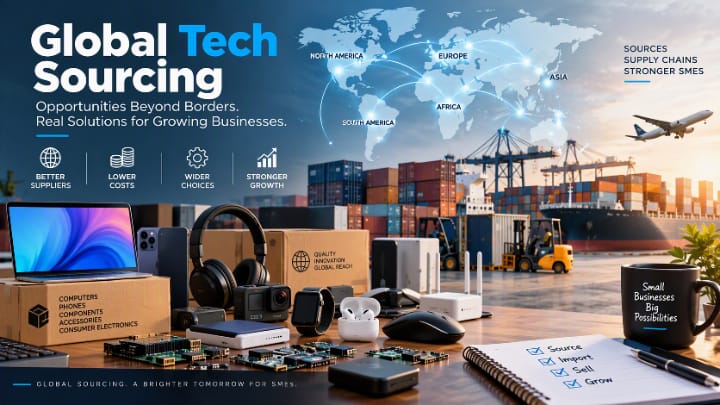
In today’s digital economy, small and medium-sized enterprises (SMEs) increasingly rely on global sourcing to access computers, mobile phones, networking equipment, electronic components, accessories, and consumer electronics. Manufacturing hubs in Asia, particularly China, Taiwan, South Korea, Vietnam, and Malaysia, have enabled businesses worldwide to obtain technology products at competitive prices.
However, global tech sourcing is no longer simply about finding the cheapest supplier. SMEs must navigate quality concerns, supply chain disruptions, counterfeit products, fluctuating exchange rates, and complex regulatory requirements. While larger enterprises often have dedicated procurement teams, SMEs must achieve the same results with fewer resources.
This article explores the key challenges facing SMEs in global technology sourcing and provides practical solutions to build a resilient and profitable sourcing strategy.
—
## Why Global Tech Sourcing Matters
Global sourcing provides SMEs with access to:
– Competitive pricing
– Wider product selection
– Latest technology products
– Specialized electronic components
– Faster business scalability
– Global manufacturing networks
According to the World Trade Organization (WTO), international trade remains an important driver of business growth and global economic integration, enabling companies to access goods and markets beyond their local economies.
For technology businesses, access to international suppliers can create a significant competitive advantage.
—
# 1. Counterfeit and Substandard Products
One of the biggest challenges in electronics procurement is the prevalence of counterfeit and low-quality products.
Common examples include:
– Counterfeit smartphones
– Fake batteries and chargers
– Refurbished devices sold as new
– Low-grade semiconductors
– Imitation accessories
For SMEs, selling counterfeit or defective products can result in:
– Customer complaints
– Product returns
– Warranty claims
– Loss of brand credibility
### How to Solve It
To minimize risks:
✅ Source from authorized distributors.
✅ Request product certifications and compliance documentation.
✅ Perform random sample testing before placing bulk orders.
✅ Establish long-term supplier relationships.
✅ Verify manufacturer part numbers and serial numbers.
Quality assurance should be considered an investment, not an expense.
—
# 2. High Minimum Order Quantities (MOQs)
Many manufacturers prioritize large-volume buyers and may require order quantities beyond the purchasing capacity of SMEs.
As a result, small businesses often face:
– Higher unit costs
– Limited supplier options
– Difficulty accessing new products
### How to Solve It
SMEs can mitigate this challenge by:
– Partnering with sourcing agents
– Joining buying consortiums
– Negotiating phased purchase agreements
– Working with authorized wholesalers
Building a consistent purchasing history often improves negotiating power over time.
—
# 3. Cash Flow Constraints
Technology products require significant upfront investment.
Typical expenses include:
– Product costs
– International freight charges
– Customs duties
– Import taxes
– Warehousing costs
Tying up excessive capital in inventory can strain cash flow and limit growth opportunities.
### How to Solve It
Best practices include:
– Purchasing based on sales forecasts
– Maintaining lean inventory levels
– Negotiating supplier credit terms
– Exploring inventory financing options
– Utilizing pre-orders where applicable
Strong cash flow management is critical for sustainable sourcing operations.
—
# 4. Supply Chain Disruptions
The electronics industry has experienced significant supply chain challenges in recent years, including semiconductor shortages, shipping delays, and geopolitical tensions.
The technology sector is particularly vulnerable because many products rely on complex global manufacturing ecosystems.
### How to Solve It
Businesses should:
– Diversify supplier locations
– Avoid dependence on a single supplier
– Maintain emergency stock levels
– Monitor global logistics trends
– Establish alternative sourcing channels
A resilient supply chain can often outperform a low-cost supply chain during periods of disruption.
—
# 5. Rapid Technology Obsolescence
Technology products have some of the shortest product life cycles of any industry.
Examples include:
– New smartphone launches
– Processor upgrades
– New operating system releases
– Emerging connectivity standards
Unsold inventory can quickly lose value.
### How to Solve It
SMEs should:
– Purchase smaller quantities more frequently
– Monitor manufacturer product roadmaps
– Focus on fast-moving stock
– Analyze historical sales data
– Use inventory management software.
Reducing inventory holding periods minimizes exposure to depreciation.
—
# 6. Logistics and Shipping Complexities
International shipping introduces multiple risks, including:
– Delayed deliveries
– Damaged goods
– Port congestion
– Customs inspections
– Rising freight costs
These issues can directly impact customer satisfaction and profitability.
### How to Solve It
Work with experienced logistics providers and freight forwarders.
Additional measures include:
– Comprehensive cargo insurance
– Real-time shipment tracking
– Standardized import documentation
– Reliable customs clearance partnerships
Efficient logistics planning reduces delays and unexpected expenses.
—
# 7. Regulatory and Compliance Requirements
Electronics imports are subject to various regulations depending on the destination market.
Requirements may include:
– Product safety certifications
– Environmental standards
– Radio frequency approvals
– Customs declarations
– Consumer protection laws
Failure to comply can result in fines, shipment seizure, or market access restrictions.
### How to Solve It
SMEs should:
– Understand local import regulations
– Engage licensed clearing agents
– Maintain accurate compliance documentation
– Verify certification requirements before procurement
Regulatory compliance should be integrated into the sourcing process from the beginning.
—
# 8. Currency Exchange Risk
Most electronics procurement transactions are conducted in US dollars.
For businesses operating in emerging markets, exchange rate fluctuations can significantly impact profit margins.
### How to Solve It
Recommended strategies include:
– Building exchange-rate buffers into pricing
– Monitoring currency trends
– Negotiating fixed-price contracts where possible
– Diversifying supplier markets
Proactive financial planning reduces procurement uncertainty.
—
# 9. Limited Warranty and After-Sales Support
Many overseas suppliers provide limited warranty coverage, leaving SMEs responsible for customer support.
Common challenges include:
– Expensive return shipping
– Delayed replacements
– Lack of spare parts
– Customer dissatisfaction
### How to Solve It
Successful companies establish:
– Local repair partnerships
– Spare-part inventory programs
– Transparent warranty policies
– Dedicated customer service processes
Exceptional after-sales support can become a major competitive differentiator.
—
# 10. Lack of Supplier Transparency
SMEs often struggle to verify:
– Manufacturing capabilities
– Production capacity
– Quality management processes
– Ethical sourcing practices
This creates uncertainty and procurement risk.
### How to Solve It
Consider:
– Third-party supplier audits
– Factory inspections
– Video verification meetings
– Supplier performance scorecards
Reliable supplier assessment improves long-term sourcing outcomes.
—
# Best Practices for Successful Global Tech Sourcing
To build a sustainable sourcing strategy, SMEs should focus on the following principles:
### Build Strong Supplier Relationships
Long-term partnerships often provide:
– Better pricing
– Priority access to products
– Improved payment terms
– Faster issue resolution
### Invest in Quality Control
Inspection and testing procedures can significantly reduce returns and warranty claims.
### Diversify Supply Sources
Avoid reliance on a single supplier, manufacturer, or country.
### Monitor Industry Trends
Stay informed about:
– Product launches
– Component shortages
– Market demand
– Regulatory changes
### Use Data-Driven Procurement
Leverage sales analytics and inventory forecasting to improve purchasing decisions.
—
# Final Note.
Global tech sourcing presents tremendous growth opportunities for SMEs involved in computers, mobile devices, networking products, electronic components, and consumer electronics. Access to international supply chains can improve competitiveness, increase product variety, and drive business expansion.
However, sourcing success requires more than securing low-cost products. SMEs must proactively manage risks associated with counterfeit goods, logistics disruptions, inventory obsolescence, regulatory compliance, supplier reliability, and currency fluctuations.
Businesses that establish strong supplier relationships, implement quality assurance processes, diversify sourcing channels, and maintain disciplined inventory management will be better positioned to thrive in an increasingly competitive global technology marketplace.
—
## References
1. World Trade Organization (WTO) – International Trade Resources: https://www.wto.org/
2. International Trade Centre (ITC) – SME Trade Development Resources: https://www.intracen.org/
3. World Customs Organization (WCO) – Customs and Trade Facilitation Guidelines: https://www.wcoomd.org/
4. OECD Trade and Global Supply Chain Reports: https://www.oecd.org/trade/
5. International Chamber of Commerce (ICC) Trade Resources: https://iccwbo.org/
### SEO Notes
– Primary Keyword: **Global Tech Sourcing**
– Secondary Keywords: **electronics sourcing**, **consumer electronics procurement**, **SME sourcing challenges**, **computer hardware sourcing**, **technology supply chain management**
– Recommended URL Slug: `/global-tech-sourcing-challenges-for-smes`
– Recommended Article Length: 1,500 to 2,000 words for improved search ranking.
– Internal Link Suggestions:
– Technology distribution services
– Global procurement solutions
– ICT hardware supply chain management
– Import and export consulting services
– Electronics distribution and logistics guide


