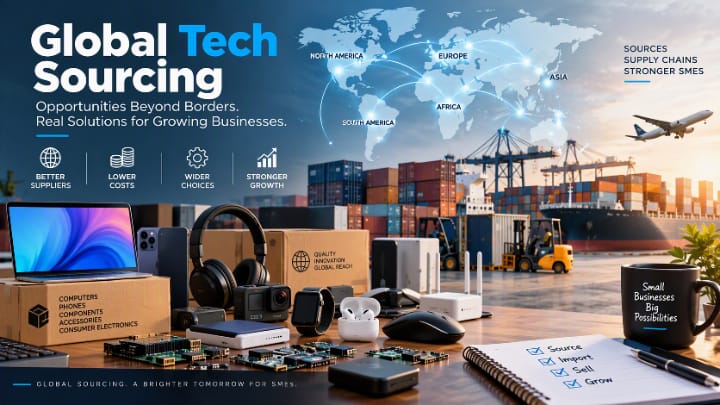
A Global Sourcing Guide from Alibaba B2B
All you need to know before you make that first order
Kindly take note of our legal disclaimer here
Global Sourcing from Alibaba: A Beginner’s Guide to Importing Wholesale Electronics
The global consumer electronics market is a goldmine for retail businesses, repair shops, and online e-commerce sellers. High-demand tech items like GaN fast chargers, magnetic wireless power banks, and braided USB-C cables carry retail markups that frequently exceed 500%.
For a beginner, the real challenge is understanding what to buy, who to buy from, how much the product will actually cost, whether it can legally be imported, and whether there is a market for it.
This guide introduces the fundamentals of global sourcing through Alibaba and the key things to consider before committing your money to a wholesale electronics order.
What Is Global Sourcing?
Global sourcing is the process of finding and purchasing products, components, or services from suppliers in other countries.
Alibaba is one of the world’s major business-to-business sourcing platforms. It connects buyers with manufacturers, wholesalers, and trading companies offering products in large or small wholesale quantities.
For example, a retailer in Africa, Europe, Asia, or North America can search Alibaba for phone accessories, smartwatches, LED lights, speakers, computer accessories, security equipment, and many other products.
The attraction is straightforward: access to a much larger supplier market and potentially competitive wholesale prices.
However, global sourcing also introduces risks that you may not encounter when buying locally.
You have to think about international shipping, customs, product standards, currency exchange, supplier reliability, quality control, and after-sales support.
That is why preparation should come before purchasing.
1. Start With the Product, Not the Supplier
One of the common mistakes beginners make is opening Alibaba and immediately searching for the cheapest supplier.
A better approach is to decide exactly what you want to source first.
Ask yourself:
- What product am I looking for?
- Who will buy it?
- What problem does it solve?
- What specifications should it have?
- What price can my customers afford?
- Is it a product people buy repeatedly or only occasionally?
- Am I looking for a generic product or a branded/private-label product?
For electronics, specifications matter particularly.
Two products may look almost identical but have significant differences in battery capacity, materials, components, power output, durability, or performance.
Instead of searching for simply “Bluetooth speaker,” for example, use “USB Bluetooth Speaker” to determine the features you actually want before comparing suppliers.
The more specific you are about the product, the easier it becomes to compare suppliers accurately.
2. Research the Market Before Importing
A product can be inexpensive on Alibaba and still be a poor business opportunity.
Before ordering, research the market where you intend to sell.
Look at:
- Who buys the product?
- What competing products are available?
- What are competitors charging?
- What features do customers value?
- How frequently is the product purchased?
- Are there seasonal fluctuations?
- Is the market already overcrowded?
- What makes your proposed product different?
Do not rely entirely on the supplier’s description of market demand.
A supplier may tell you that a particular product is a “hot seller,” but your own market may tell a different story.
Your objective is to identify a product that has a real customer and a realistic selling price.
3. Know Your Budget
Your Alibaba order is only one part of the investment.
A beginner may see a product listed for $5 and think:
“If I buy 100 units, my investment is only $500.”
Your actual expenses may include:
- Product cost
- Sample costs
- Custom packaging
- Logo/branding
- International shipping
- Cargo insurance
- Import duties
- Taxes
- Customs clearance
- Inspection fees
- Port or airport charges
- Local transportation
- Storage
- Marketing
- Payment and currency-conversion fees
You should therefore determine your total importing budget, not just your product budget.
It is also wise to keep a contingency amount rather than committing every available dollar to inventory.
4. Understand Your Country’s Import Rules
Global sourcing is international, but importation is local.
The rules that apply to an electronic product depend partly on the country where you intend to sell it.
Before ordering, investigate the regulations in your destination country.
Depending on the product, you may need to understand:
- Import licensing
- Customs requirements
- Product certification
- Electrical safety standards
- Labelling requirements
- Wireless/radio regulations
- Battery regulations
- Environmental requirements
- Restricted or prohibited goods
- Product-specific approvals
This is particularly important with electronics.
A product that can be freely sold in one country may require additional certification or approval in another.
Never assume that because a product is listed on Alibaba, you are automatically permitted to import and sell it in your country.
5. Check the Product’s Technical Requirements
Electronics require more attention than many ordinary consumer goods.
Before buying, investigate specifications such as
- Voltage
- Frequency
- Plug type
- Power rating
- Battery capacity
- Charging requirements
- Wireless technology
- Frequency bands
- Compatibility
- Safety features
- Applicable certifications
For example, a charger designed for one electrical system may not be appropriate for another market.
Similarly, wireless devices can be subject to country-specific rules governing radio frequencies and communications equipment.
Ask the supplier for technical specifications and relevant test reports or certificates where applicable.
6. Understand Customs Classification and HS Codes
International trade uses a classification system known as the Harmonized System (HS).
Products are assigned HS codes that customs authorities use to classify goods and determine applicable duties and taxes.
The correct classification can affect the cost of importing your product.
Before placing a significant order, find out:
- What HS code applies to the product?
- What import duty applies?
- Are there additional taxes?
- Are there special charges?
- Does the product require inspection or certification?
- Are there country-specific import restrictions?
If you are unsure, consult your customs authority or a qualified customs broker.
Do not simply rely on a supplier’s suggested HS code without checking whether it is appropriate for your destination.
7. Calculate the Landed Cost
One of the most important concepts for a beginner importer is landed cost.
The Alibaba price is not necessarily the cost of getting the product into your warehouse.
A simplified calculation is:
Product cost + packaging + international shipping + insurance + duties/taxes + customs/clearance charges + other applicable costs = Landed cost
Suppose you buy 500 units at $4 each.
Your product cost is:
500 × $4 = $2,000
But imagine the additional costs amount to another $1,000.
Your actual investment becomes approximately $3,000.
Your effective cost per unit is therefore,
$3,000 ÷ 500 = $6 per unit
That $6—not $4—is the figure you should use when calculating your potential margin.
8. Determine Your Minimum Order Quantity
Alibaba suppliers often quote an MOQ, or Minimum Order Quantity.
For example, a supplier might require you to purchase 100, 500, or 1,000 units.
A large MOQ can reduce your unit price, but it also increases your financial risk.
As a beginner, ask:
- How quickly can I sell this quantity?
- How much capital will be tied up?
- Do I have storage?
- What happens if demand is lower than expected?
- Can I start with a smaller quantity?
- Does the supplier offer samples or a trial order?
A lower unit price isn’t automatically better if you end up holding hundreds of unsold products.
9. Decide Whether You Need a Sample
For electronics, sampling is extremely important.
Never assume that the product shown in photographs will meet your expectations.
A sample allows you to evaluate:
- Build quality
- Performance
- Battery life
- Materials
- Packaging
- Accessories
- User experience
- Product specifications
- Charging performance
- Appearance
- Functionality
If possible, compare samples from several suppliers.
A supplier who offers the lowest price may not necessarily provide the quality you need.
A small amount spent testing a product can prevent a much larger loss on a bulk order.
10. Find and Evaluate Alibaba Suppliers
Once you know the product you want, you can begin looking for suppliers.
Don’t contact only one supplier.
Create a shortlist and compare several.
Look at factors such as:
- Years in business
- Supplier verification
- Trade Assurance availability
- Product range
- Manufacturing capabilities
- Export experience
- Customer feedback
- Response time
- Communication quality
- Certifications
- Production capacity
- Customization capabilities
Also determine whether you are dealing with a manufacturer or trading company.
Neither is automatically right or wrong.
A manufacturer may offer greater control over production and customization, while a trading company may provide access to multiple factories and a wider product range.
The important thing is to understand who you are dealing with.
11. Ask Suppliers the Right Questions
Good sourcing involves asking questions before paying.
Your initial inquiry could cover:
- What is your MOQ?
- What is your best price for my quantity?
- Can I order a sample?
- What is the sample cost?
- How long does production take?
- What are the product specifications?
- What certifications are available?
- Can you provide test reports?
- What packaging options are available?
- Can you add my logo?
- Do you offer OEM or ODM?
- What is your warranty?
- What is your defect/replacement policy?
- What shipping options do you offer?
- What are your payment terms?
Don’t be afraid to ask detailed technical questions.
A serious supplier should be able to provide clear information about the product they are selling.
12. Think About Branding Before You Order
Alibaba is not only about buying generic products.
Many suppliers offer OEM and ODM services.
OEM generally involves producing a product according to a buyer’s specifications or branding requirements.
ODM generally involves a supplier providing an existing product/design that can be customised.
You may also be able to customise:
- Logo
- Packaging
- Product colour
- User manuals
- Labels
- Accessories
- Product specifications
However, don’t rush into private labelling on your first order.
It can increase the MOQ and add design, packaging and production costs.
Start by understanding your market and product before investing heavily in branding.
13. Protect Yourself From Counterfeit and Intellectual-Property Problems
Electronics can involve significant intellectual-property issues.
Be cautious about products carrying famous brand names or designs.
A supplier telling you that a product is “original” does not automatically mean that you have the legal right to import and sell it in your market.
Avoid counterfeit goods and investigate trademark, copyright, patent and design issues where relevant.
If you want to build a long-term business, it is safer to develop a legitimate product and brand rather than depend on questionable branded merchandise.
14. Choose the Right Shipping Method
Once you purchase internationally, you need to get the goods from the supplier to your destination.
Common options include:
A. Air freight
Generally faster but often more expensive.
B. Sea freight
Usually more economical for larger shipments but slower.
C. Express courier
Useful for samples and small shipments.
D. Consolidated shipping
Multiple shipments may be combined into one cargo shipment.
The best option depends on:
- Quantity
- Weight
- Volume
- Product value
- Urgency
- Destination
- Available budget
For electronics containing batteries, additional shipping requirements may apply, so confirm the carrier’s rules before ordering.
15. Understand Incoterms
You will encounter terms such as:
- EXW
- FOB
- CIF
- DAP
- DDP
These are Incoterms, internationally recognised rules that help define responsibilities between buyers and sellers.
They determine matters such as who arranges transportation, who bears certain costs and where responsibility for the goods transfers.
A beginner should never agree to an Incoterm they don’t understand.
A supplier’s “cheap price” can become much less attractive once you discover that significant transportation or import costs are your responsibility.
16. Consider Insurance
International transportation involves risk.
Goods can be damaged, lost or delayed during transportation.
For valuable electronics, consider appropriate cargo insurance.
Understand:
- What is covered?
- What isn’t covered?
- Who purchases the insurance?
- What documentation is required for a claim?
- What happens if goods arrive damaged?
Don’t assume that the shipping company automatically covers the full value of your goods.
17. Plan for Defective Products
Even reputable manufacturers can have defective units.
Before placing an order, agree on:
- Acceptable defect rate
- Inspection standards
- Warranty period
- Replacement arrangements
- Refund conditions
- Spare parts
- Who pays return shipping
- How defective products will be documented
For larger orders, consider using an independent inspection service before the goods leave the supplier.
It is generally easier to identify problems before shipment than after the entire order has arrived.
18. Think About After-Sales Service
Your responsibility doesn’t necessarily end when you sell the product.
Customers may return with:
- Faulty products
- Charging problems
- Battery issues
- Missing accessories
- Software problems
- Warranty claims
Before importing, ask yourself:
If this product fails after I sell it, what will I do?
You may need:
- Spare parts
- Replacement units
- Repair arrangements
- Technical support
- Warranty procedures
A cheap product with poor after-sales support can become expensive for your business.
19. Understand Payment and Currency Risks
International transactions can involve currency fluctuations and payment fees.
Consider:
- Which currency you will pay in
- Exchange-rate movements
- Bank charges
- Payment-processing fees
- Supplier deposit requirements
- Balance payment terms
- Payment protection
When using Alibaba, understand the protections available through the platform and keep important transaction details within the platform’s communication and ordering system.
Never allow urgency or pressure from a supplier to make you ignore basic payment safeguards.
20. Have a Plan for Selling the Product
Before importing hundreds of units, know where those units are going.
Possible sales channels include:
- Physical retail
- Online stores
- Social media
- WhatsApp Business
- Online marketplaces
- Wholesale distribution
- Resellers
- Corporate customers
- Institutional buyers
Work backwards from your customer.
If you expect to sell at $15 per unit, for example, determine whether your landed cost leaves enough margin to cover your operating expenses, marketing, returns and other business costs.
21. Prepare for the Unexpected
International sourcing doesn’t always go according to plan.
Ask yourself:
What happens if the shipment is delayed?
What happens if customs holds the goods?
What happens if the supplier sends the wrong product?
What happens if some units are defective?
What happens if the exchange rate changes?
What happens if the product doesn’t sell?
What happens if the supplier cannot fulfil the next order?
Having contingency plans can make the difference between a temporary setback and a serious business loss.
22. Start Small and Learn
Your first Alibaba order should be treated as a learning experience.
You don’t need to begin with a container full of products.
A smaller test order can help you learn:
- How your supplier communicates
- How the product performs
- How shipping works
- How customs works
- How customers respond
- What your actual landed cost is
- What your real profit margin looks like
Once you have reliable data, you can increase your order size.
Test → Learn → Improve → Reorder → Scale.
This approach can be much safer than committing a large amount of capital before you understand the entire importing process.
Final Checklist Before You Place Your First Alibaba Order
Before clicking the payment button, make sure you can answer these questions:
☐ What exactly am I buying?
☐ Who is my target customer?
☐ Have I researched the market?
☐ Have I compared several suppliers?
☐ Have I verified the supplier?
☐ Have I requested a sample?
☐ Have I tested the product?
☐ Do I understand the product specifications?
☐ Is the product legally importable into my destination country?
☐ Does it require certification?
☐ Do I know its correct customs classification?
☐ Have I calculated the landed cost?
☐ Do I understand the supplier’s MOQ?
☐ Have I considered defective products and warranty?
☐ Do I understand the shipping method?
☐ Do I understand the applicable Incoterm?
☐ Have I considered insurance?
☐ Do I understand the payment terms?
☐ Do I know how I will sell the products?
☐ Do I have enough financial room for unexpected costs?
If several of these questions have no clear answer, the order probably needs more preparation before you commit your money.
The Bigger Picture
Alibaba has made global sourcing more accessible, but accessibility should not be confused with simplicity.
Successful importing is not about finding the cheapest product or the supplier with the lowest quotation.
It is about putting together the entire chain:
Market → Product → Supplier → Quality → Compliance → Cost → Shipping → Customs → Customer → Profit
When these pieces work together, Alibaba becomes more than a website for finding cheap products. It becomes a tool for building an international supply chain.
For a beginner, the smartest place to start is not with a large order.
Start with research. Start with samples. Start with a manageable order. Learn the process—and scale when the numbers make sense.